
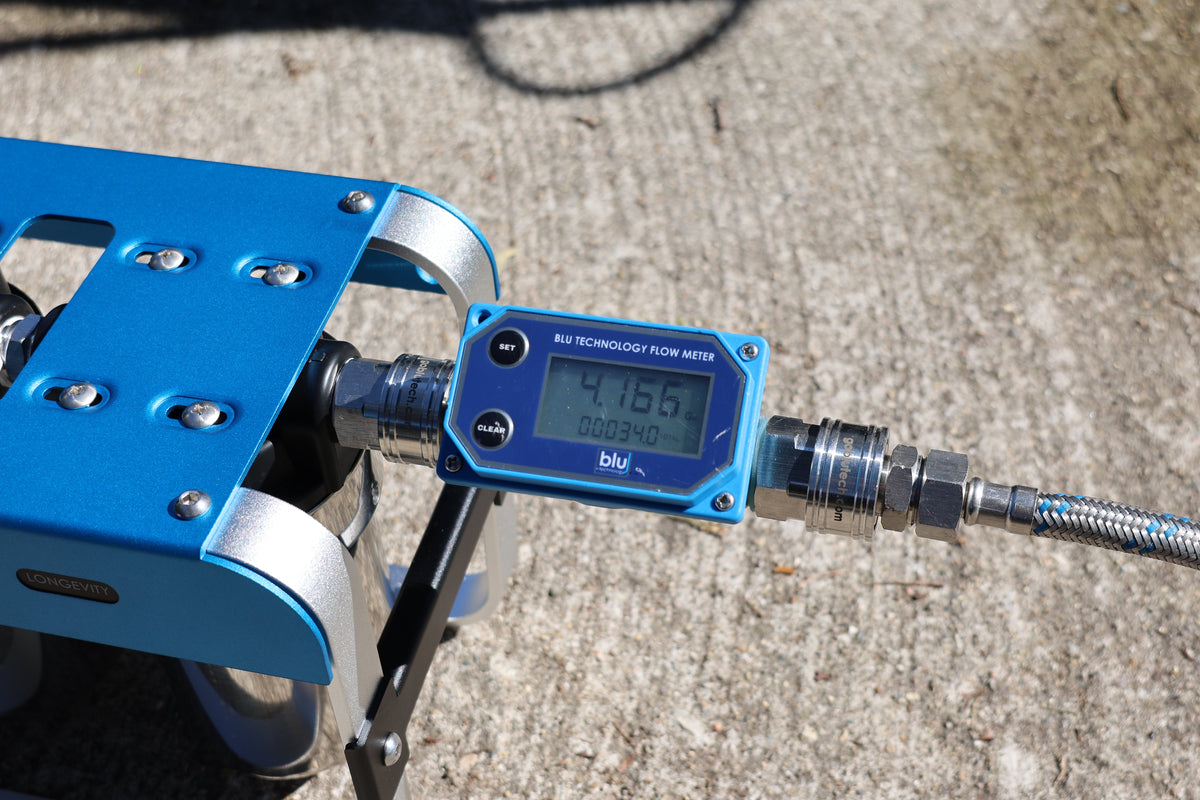
Gallons per minute, or GPM, measures how much water moves through an RV water system each minute. It affects shower performance, faucet output, tank-fill speed, and the ability to use multiple fixtures at once.
There is no single GPM requirement for every RV. The right flow depends on the available water pressure, plumbing design, number of fixtures being used, and every component installed between the water source and the tap.
GPM and PSI Measure Different Things
GPM measures the volume of water moving through the system. PSI measures the force pushing that water.
An RV can have adequate pressure and still experience limited flow. A restrictive filter, narrow hose, undersized fitting, partially closed valve, or loaded cartridge can limit the amount of water reaching a fixture even when the pressure reading appears normal.
A campground connection can also provide pressure above the RV manufacturer’s recommended range. A pressure regulator helps manage that force, but it must be sized to support the required flow.
Pressure moves the water. GPM tells you how much is delivered.
How Much Flow Does an RV Need?
Most RVs do not need every fixture operating at full output simultaneously. The appropriate flow rate should support the fixtures most likely to be used together.
For example:
-
Shower: approximately 1.5 GPM
-
Kitchen faucet: approximately 1.0 GPM
-
Bathroom faucet: approximately 0.5 GPM
If the shower and kitchen faucet are used together, the system may need to deliver approximately 2.5 GPM at the fixtures under actual operating conditions.
These are general examples. Fixture specifications vary, and actual output depends on pressure, plumbing, valves, aerators, and the complete water path.
Many RVs can function with approximately 2-3 GPM when one fixture is used at a time. Larger coaches, multiple occupants, and simultaneous fixture use may benefit from 4 GPM or more. However, the RV’s plumbing and fixtures will still determine how much water reaches each outlet.
Where RV Water Flow Is Lost
The flow available at a campground spigot is not necessarily the flow delivered at the shower. Water must pass through the hose, regulator, fittings, valves, filtration system, water softener, and RV plumbing. Each component creates resistance.
Common restrictions include:
-
Long or narrow hoses
-
Small internal fitting diameters
-
Restrictive pressure regulators
-
Excessive adapters
-
Kinked hoses
-
Partially closed valves
-
Loaded filter cartridges
-
Mineral buildup
-
Limited campground supply
One restrictive component can limit the entire system.
Connection size alone does not establish flow. A product may use a standard ¾-inch garden-hose thread while containing a much smaller internal opening. When evaluating equipment, review the tested flow rate of the assembled product—not only the size of its connections.
How Filtration Affects GPM
Every filtration stage creates resistance because water must move through the filter media. The amount of resistance depends on the media type, micron rating, surface area, cartridge size, condition, and system design.
Finer filtration can create more resistance than a basic sediment screen, especially when the cartridge has limited surface area. Flow may also decrease as the filter collects material.
This does not mean advanced filtration must produce poor flow. Larger surface areas, appropriately sized housings, efficient internal pathways, and high-flow connections can help balance filtration performance with practical RV use.
Micron rating is not a flow rating. It describes the approximate size of particles a filter is designed to capture, not how much water the filter can process per minute. Two filters with the same micron rating may produce different flow because of differences in media, surface area, construction, and operating pressure. A flow claim without its test conditions provides limited information.
City Water and Onboard Pumps
An RV can receive water from a pressurized campground connection or from its fresh-water tank through an onboard pump.
At a campground hookup, performance depends on the source pressure, available flow, regulator, hose, filtration equipment, and RV plumbing. Conditions may change between campgrounds or throughout the day.
When using the fresh-water tank, the pump establishes the maximum available flow before other restrictions are considered. If the pump is rated for 3 GPM, installing filtration equipment rated for 5 GPM will not make the pump deliver 5 GPM.
Hose diameter and length also matter. A long or narrow hose creates more resistance than a shorter hose with a larger internal diameter. To support flow, use only the hose length needed, minimize unnecessary adapters, prevent kinks, and choose fittings with full-flow internal pathways.
Do You Need the Highest Available GPM?
Not necessarily.
Higher flow capacity can support simultaneous fixture use and faster tank filling, but the system must still operate within the RV manufacturer’s pressure and plumbing requirements.
High GPM does not automatically mean better filtration. Advanced filtration also does not have to mean poor flow. Choose the flow capacity that fits the RV rather than selecting the largest number available.
Actual performance will depend on the campground supply, incoming pressure, regulator, hose, filter condition, RV plumbing, and fixtures. Blu Technology accessories can help RVers manage these variables as part of the complete water path. A pressure regulator helps control incoming pressure before water enters the RV, while a flow meter provides greater visibility into water use.
Share:
Can I Drink Campground Water?
How to Choose an RV Water Filtration System