
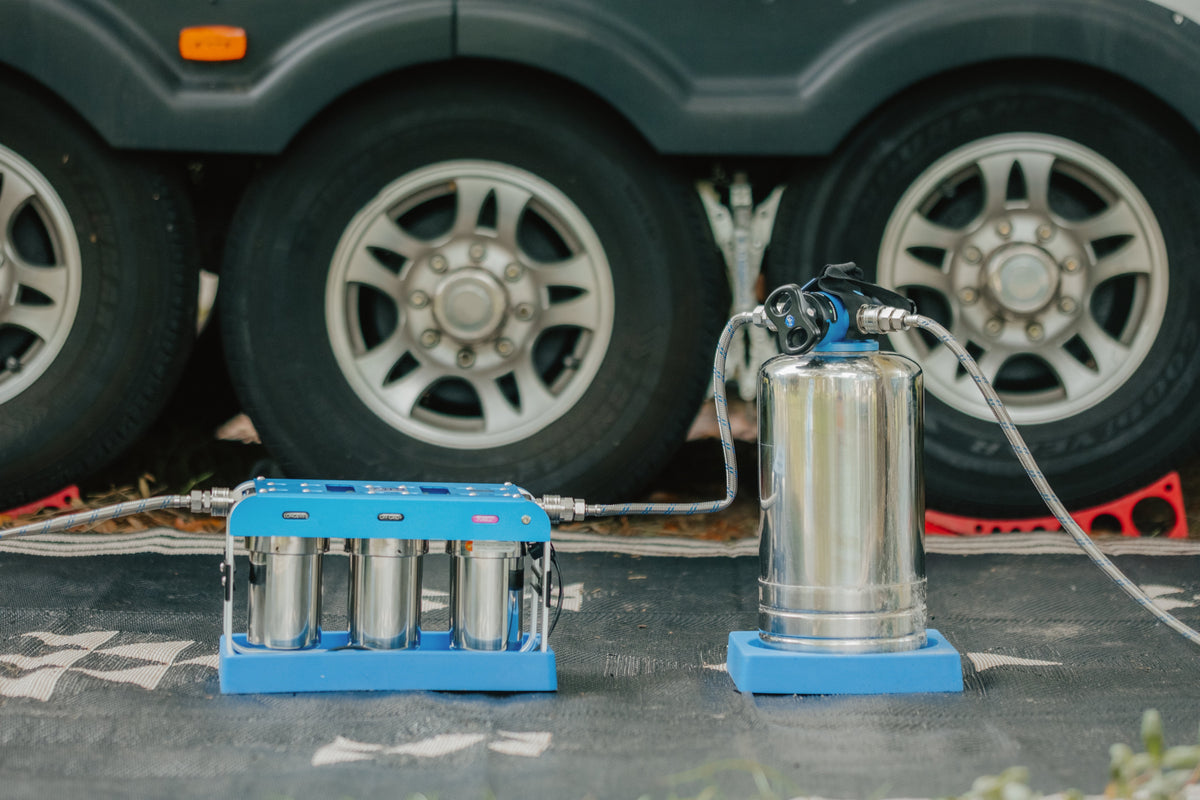
The right RV water filtration system is not determined only by how often you camp or how much the equipment costs. It depends on your water source, what you want reduced, the flow you expect, and whether your system also needs UVC treatment, reverse osmosis, or water softening.
A weekend traveler may encounter several unfamiliar campground water sources in one season. A full-time RVer may stay primarily within a familiar municipal network. Travel frequency matters, but your water-quality goals should guide the decision.
Start by identifying the concern. Then select the technology designed to address it.
Match the Technology to Your Water Goals
Each water-treatment technology performs a different job:
-
Inline filters capture larger particles before they move farther into the system.
-
Carbon filters helps reduce chlorine taste, odor, and other aesthetic concerns supported by the filter’s testing.
-
UVC treatment provides a separate active microbiological treatment barrier after filtration.
-
Reverse osmosis uses membrane separation to reduce certain dissolved substances.
-
Water softening reduces hardness minerals such as calcium and magnesium.
These technologies are not interchangeable. A sediment filter does not soften water. A water softener does not perform the same job as filtration. UVC treatment does not reduce dissolved chemicals, and reverse osmosis does not replace every component in a complete RV water system.
The goal is not to add every available technology. It is to give each stage a defined purpose.
Inline Filters and Multi-Stage Systems
A typical $20-$40 inline filter can be a practical choice for basic filtration. Depending on the cartridge and its verified claims, it may help reduce sediment and improve taste or odor.
Inline filters are compact, portable, and inexpensive. Their limitations come from the same compact design. One small cartridge has limited capacity to perform several jobs, and filtration media, flow, construction, service life, and supporting test data vary between products.
Multi-stage filtration distributes the work across several purpose-selected filters. A system may use one stage for sediment, another for finer filtration, and a third for activated carbon.
The number of canisters alone does not establish performance. A three-stage system provides value only when every filter has a defined function and the stages are arranged to work together.
Compare the technology inside each canister, not just the exterior appearance of the system.
UVC Treatment as an Additional Barrier
Filtration and UVC treatment perform different jobs.
Filtration passes water through specialized media or pores designed to capture or reduce specific substances. UVC treatment exposes pre-filtered water to ultraviolet light as an active microbiological treatment step.
UVC may make sense when your water sources change frequently or when you want an independent active treatment barrier in addition to filtration. Pre-filtration is an important part of the system because it reduces particulate load before the water reaches the UVC stage.
Reverse Osmosis for PFAS, Nitrate, and Dissolved Substances
Reverse osmosis, commonly called RO, is designed to reduce certain dissolved substances that conventional sediment and carbon filters may not address.
An RO system forces water through a semi-permeable membrane. Depending on the system and its verified reduction claims, reverse osmosis may reduce dissolved salts, certain metals, nitrate and nitrite, and specific PFAS compounds such as PFOA and PFOS.
These claims require careful evaluation. PFAS describes thousands of different compounds. A system with a verified claim for PFOA and PFOS reduction should not be assumed to address every PFAS compound.
Nitrate reduction also depends on the membrane, incoming concentration, water pressure, system condition, and maintenance. Review the exact third-party certification and reduction data for the specific RO system being considered.
In an RV, reverse osmosis is generally used as a point-of-use system connected to a dedicated faucet rather than as a whole-RV solution. RO systems process water more slowly than conventional filtration, require adequate incoming pressure, and produce wastewater during operation. Many also require a storage tank.
Reverse osmosis is not automatically necessary for every RV. It should address an identified concern from a user and fit the RV’s available space, water capacity, pressure, and maintenance requirements.
Water Softening for Hard-Water Minerals
Filtration is not softening.
A water softener addresses hardness minerals, primarily calcium and magnesium. It may be useful if you regularly encounter hard water, notice scale on fixtures, experience reduced soap lathering, or want to help protect plumbing and appliances from mineral buildup.
Compare the Complete Cost of Ownership
Upfront price matters, but it does not represent the complete cost of owning a filtration system. A higher price also does not automatically establish better performance.
Consider:
-
Initial purchase price
-
Replacement-filter costs
-
Recommended replacement frequency
-
Availability of replacement filters
-
Housing durability
-
Maintenance requirements
-
Warranty and technical support
-
Expected service life
-
Ability to expand the system
A premium system should justify its price through verified performance, durable materials, usable flow, thoughtful engineering, and long-term serviceability.
Choose Based on Your Water, Not Just Your Camping Schedule
Weekend RVers do not automatically need only basic filtration. Full-time RVers do not automatically need the most advanced system available.
A family taking several trips per year may encounter unfamiliar campground sources and choose advanced whole-RV filtration. A full-time traveler using a consistent municipal supply may have different priorities.
Base the decision on:
-
Water-source variability
-
Specific substances or conditions of concern
-
Desired filtration and treatment level
-
Flow requirements
-
Hard-water exposure
-
Available storage space
-
Setup and maintenance preferences
-
Long-term ownership plans
Travel frequency helps shape the decision. Your water goals should determine it.
Five Questions to Ask Before You Buy
Before selecting an RV water filtration system, answer these questions:
-
What substances or conditions do I want the system to address?
-
What types of water sources will I encounter?
-
What flow rate do I expect throughout my RV?
-
What testing or certification supports the product’s claims?
-
How will the system fit my available space, setup, maintenance, and ownership needs?
The right RV water filtration system is not automatically the least expensive or the most complex. It is the system engineered around your water goals, expected sources, and RV setup.
Start with the concern. Select the appropriate technology. Then verify the performance behind the claim.
There are many variations out in the market, but the team at Blu Technology has made it easy for you to choose. Visit our site and take the quiz “What Type of Water Filtration System Is Right for Me?” and we’ll point you in the right direction. Blu Technology engineers complete Mobile Water Safety Systems, from advanced multi-stage filtration and water softening to active PURBLU® UVC treatment.
Share:
GPM Explained: How Much Water Flow Does an RV Need?
What Is the Difference: RV Water Filter vs. UV Purifier?