
You pull into a campground, connect your water, turn on the faucet—and something tastes different.
Maybe it has a strong chlorine taste. Maybe it is metallic, sulfur-like, or simply stale. One campground may have water that tastes perfectly normal to you, while the next produces a noticeable taste almost immediately.
That variability is part of RV travel. Unlike at home, where your water source generally stays the same, RVers can connect to a completely different supply every time they move. The campground source is not the only thing that can affect taste: your fresh-water tank, water heater, plumbing, filtration system, and even how long water has been sitting can all play a role.
The taste itself can often provide a useful clue. The key is figuring out where it is coming from before deciding how to address it.
First, Figure Out Where the Taste Starts
Before changing filters or adding treatment equipment, try to narrow down the source of the problem.
Does the water have the same taste directly from the campground connection before it enters your RV? Is the taste noticeable from both the hot and cold faucets, or only from the hot side? Does it happen while connected directly to campground water, only when using the fresh-water tank, or both?
Those simple comparisons can tell you a lot.
If the taste is present before the water ever reaches the RV, the source water is the more likely explanation. If the campground water seems normal but the taste appears inside the RV, it may be worth looking at the tank, water heater, plumbing, filtration system, or another component downstream.
Taste and odor should not be treated as a complete water-quality test, however. Some substances can create a strong taste or odor without indicating a larger concern, while other water-quality issues may produce no obvious taste, smell, or appearance at all. If something about a source seems unusual or you are uncertain about its quality, testing provides much more useful information than taste alone.
Why Does My RV Water Taste Like Chlorine?
A chlorine or chemical taste is one of the more common complaints RVers can encounter, particularly when connecting to municipal water.
Public water systems commonly use chlorine or chloramine during treatment. Depending on the source and treatment level, that can create a noticeable difference in taste or smell.
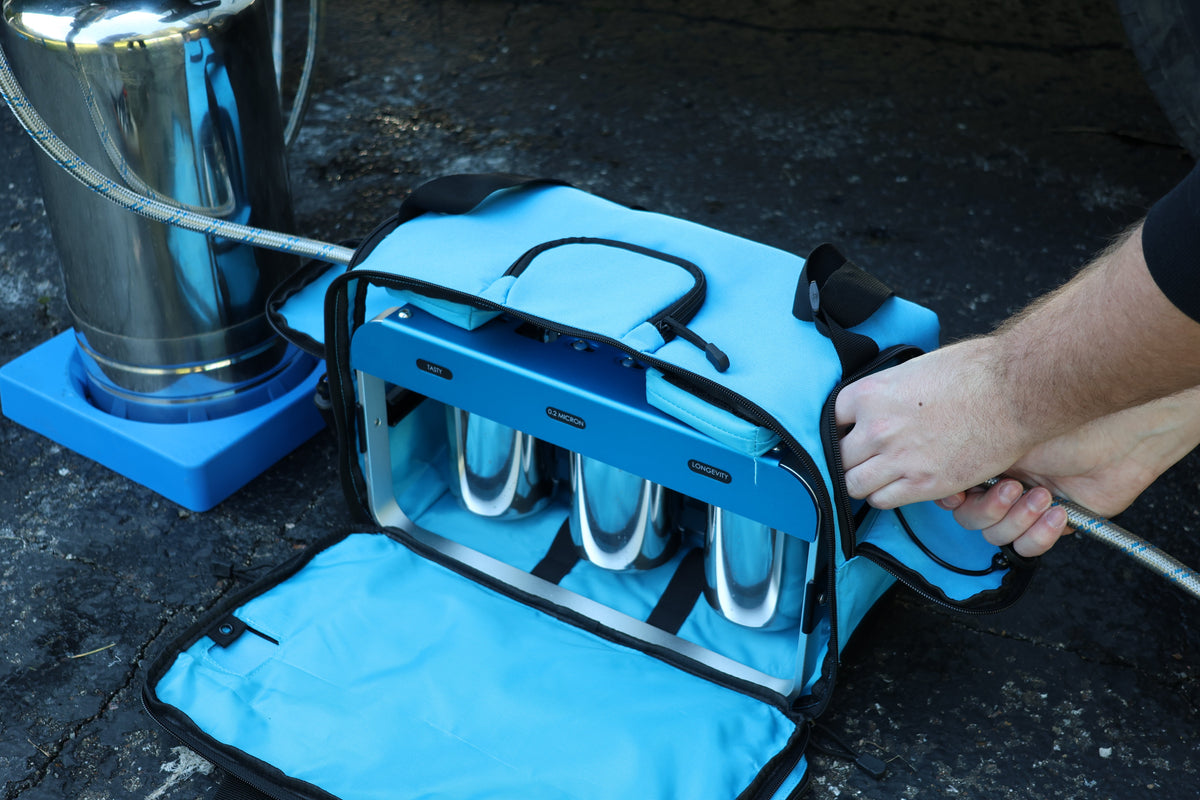
This is one of the situations where activated carbon filtration can be useful. Blu Technology™ uses the TASTY™ filter, an activated coconut-shell carbon filtration stage designed to improve taste and address chlorine-related water-quality concerns.
For the average campground connection with an unpleasant chlorine taste, carbon filtration may be all that is needed to make the water more enjoyable at the tap.
There are also locations where chlorine levels or other source-water conditions are particularly challenging. In those cases, a specialized treatment option such as the CHI Filter™ may be worth considering. It is designed to help reduce higher levels of chlorine along with hydrogen sulfide and iron before the water reaches the RV's primary filtration system.
The important point is to match the treatment to the problem. A chlorine taste does not automatically mean you need to rebuild your entire water setup.
Why Does My RV Water Smell or Taste Like Rotten Eggs?
That unmistakable rotten-egg smell commonly points toward hydrogen sulfide.
The first question to ask is whether you notice it in both hot and cold water.
If the sulfur-like odor is present throughout the RV, the source water may be responsible. Groundwater and well-water sources can contain naturally occurring constituents that affect taste and odor, which is one reason the water at two campgrounds in the same region can still seem very different.
When hydrogen sulfide is part of the source-water problem, the CHI Filter is specifically designed to help reduce it before the water moves farther into the RV system.
If the rotten-egg smell appears only from the hot-water side, however, the campground source may not be the culprit at all. The water heater deserves a closer look. Certain water conditions can interact with components inside a water heater and contribute to sulfur-like odors, which is why comparing the hot and cold faucets is such a useful first troubleshooting step.
In other words, do not automatically assume every unpleasant smell requires another water filter. Sometimes identifying where the odor appears is more valuable than immediately treating the incoming source.
Why Does My RV Water Taste Metallic?
A metallic taste can have several possible sources.
Iron and manganese commonly occur in groundwater, and elevated levels can noticeably affect taste, odor, color, and staining. Water chemistry and corrosion within plumbing can also contribute to metallic tastes.
Look for other clues alongside the taste. Reddish or brown staining can point toward iron, while darker staining may indicate manganese. If you repeatedly encounter these characteristics from particular campground or well-water sources, the source itself may be driving the problem.
This is another application where the CHI Filter may help because it is designed to address iron along with chlorine and hydrogen sulfide.
Hard water is related but different. Calcium and magnesium are the primary minerals associated with hardness. Hard water may contribute to mineral buildup, spotting, changes in soap performance, and differences in how the water feels or tastes.
If those signs accompany the taste you are noticing, a water softener may be useful. A softener is designed to help reduce hardness-causing minerals rather than perform the same job as a conventional filtration system.
Again, the goal is not to add every form of treatment. It is to determine whether you are dealing with filtration, iron, hardness, or another source-water characteristic and choose accordingly.
Why Does My RV Water Taste Stale or Musty?
Sometimes the campground source is not the issue at all.
If water tastes normal when you're connected directly to the source but develops an unpleasant or stale character when you switch to the fresh-water tank, start looking inside the RV.
Water that sits unused can change over time. This is especially relevant after an RV has been stored, after the fresh-water tank has remained full for an extended period, or when parts of the plumbing have seen very little flow.
In an RV, flushing the tank and plumbing is a logical first step. If the system has been sitting for an extended period or a refresh is due, the fresh-water tank, plumbing, filtration equipment, and related components may also need to be properly refreshed according to their manufacturer instructions.
This is also a good reason to distinguish between source-water treatment and system maintenance. Filtration can address characteristics of the water coming into the RV, but it does not replace appropriate maintenance of the tank and plumbing.
Could the Water Filter Itself Be Part of the Problem?
It is worth checking.
A filtration system needs regular maintenance to continue performing as intended. If water that normally tastes good through your system suddenly changes, think about what has changed recently.
Has a filter been in service longer than usual? Did you encounter particularly challenging water at the last few stops? Was the filtration system stored for an extended period? Were the filters removed or stored according to their instructions during winterization or long-term storage?
The activated-carbon stage deserves particular attention when taste and odor are the primary complaint. Carbon has a specific job within the filtration system, and maintenance matters if you expect it to continue performing that job.
Rather than assuming the source water suddenly changed, checking the condition and maintenance status of the filtration system can sometimes reveal a much simpler explanation.
What If the Water Tastes Salty?
A salty taste points in a different direction.
Higher concentrations of dissolved solids, including chloride and sodium, can affect how water tastes.
This is an important example of why identifying the actual problem matters before choosing treatment. A standard carbon filter is designed for a different job, and a conventional water softener is intended to address hardness—not to correct salty source water.
If a campground source has an unusually strong salty taste, particularly when the taste is also present directly at the source, finding out more about that source or having the water tested is a better next step than assuming another filtration stage will solve it.
Bad-Tasting RV Water Is a Clue—Start With the Cause
When RV water tastes bad, the solution is not automatically “get a bigger filter.”
Start by identifying the taste, then narrow down where it begins.
A chlorine taste may point toward the treatment used by the campground's water supply and may respond well to activated-carbon filtration. A rotten-egg smell may indicate hydrogen sulfide—or, when limited to hot water, something happening inside the water heater. Metallic characteristics can point toward iron, manganese, water chemistry, or plumbing. Hard-water symptoms may make a softener worth considering. Stale or musty water that appears after storage may mean the tank and plumbing need attention instead of the incoming source.
That diagnostic approach also helps avoid treating every water problem as though it were the same. Your RV moves. Your water sources change. The way the water tastes can change with them. The useful question is not simply, “Why does my RV water taste bad?” It is, “Where is that taste coming from?”
Once you know that, choosing what to do next becomes much easier.
Share:
2-Stage vs. 3-Stage RV Water Filtration: Which Setup Fits the Way You Travel?