
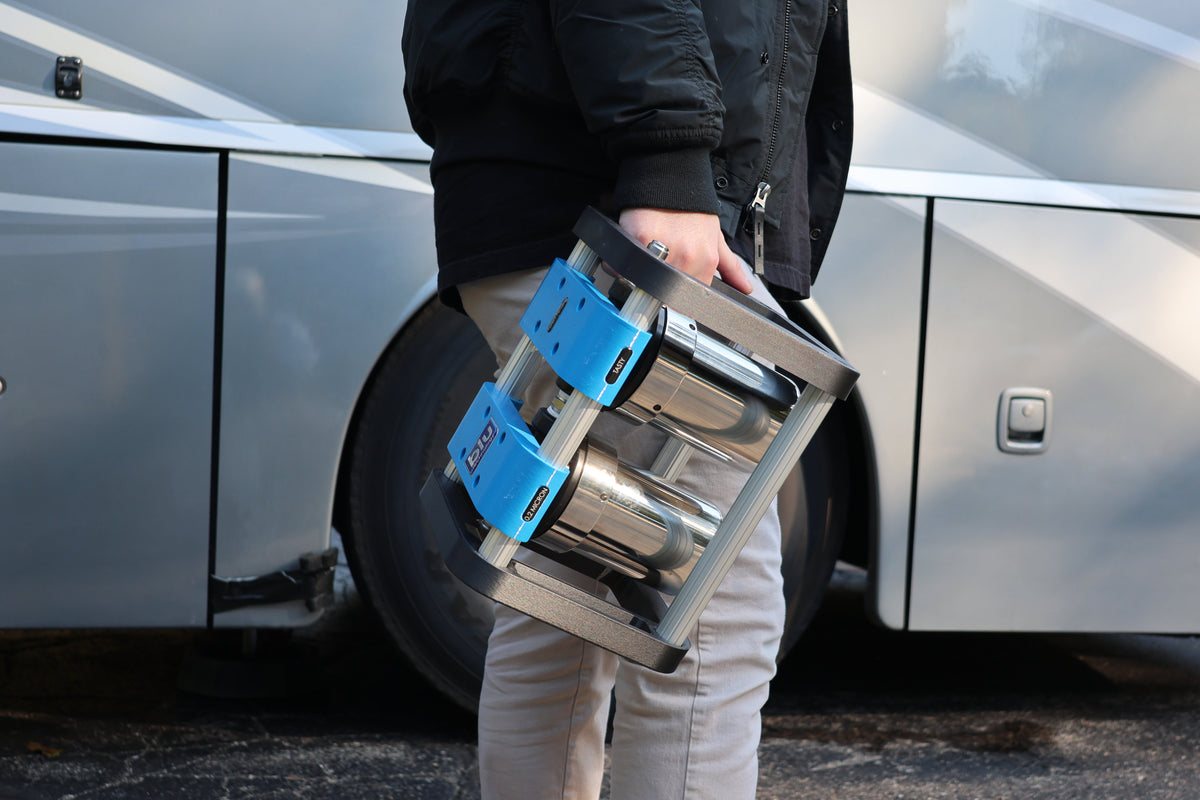
When you're choosing an RV water filtration system, it is easy to assume that more stages automatically mean better filtration. But that is not necessarily the case.
A 2-stage and a 3-stage RV water filtration system can share the same core filtration functions. The real difference is what that additional stage is designed to handle and whether your source-water conditions call for it. For RVers, that makes the decision less about choosing the system with the bigger number and more about understanding the water you typically connect to, the space available in your RV, and the job you want your filtration system to perform.
The Main Difference Between 2-Stage and 3-Stage RV Water Filtration
In Blu Technology™ systems, the 2-stage configuration uses OFFGRID™ filtration followed by TASTY™ activated carbon filtration. OFFGRID is designed for fine contaminants at the 0.2-micron level, while TASTY uses activated coconut-shell carbon to improve taste.
The 3-stage configuration uses those same two filtration functions but adds LONGEVITY™ as a dedicated first stage. LONGEVITY is designed to address larger sediment at the 5-micron level before the water reaches OFFGRID and TASTY.
So the difference is straightforward: 2-Stage: OFFGRID → TASTY. 3-Stage: LONGEVITY → OFFGRID → TASTY. The third stage does not replace or improve upon the other two. It adds a specific sediment-management function ahead of them, and that distinction is what should drive the decision.
How Does a 2-Stage RV Water Filtration System Work?
A 2-stage system combines two complementary filtration functions in a more compact configuration. Water first passes through OFFGRID, which is engineered to address fine contaminants at the 0.2-micron level. It then moves through TASTY, where activated coconut-shell carbon helps improve taste.
For RVers who primarily connect to established campground or municipal water supplies and do not routinely encounter significant sediment, that combination may be exactly what they need.
There is also a practical benefit to the two-stage configuration: fewer filter housings mean a smaller overall footprint. RV wet bays and storage compartments are rarely generous with space, so a streamlined filtration setup can be an advantage when sediment management is not a major concern.
A 2-stage system should not be viewed as an incomplete version of a 3-stage system. It is a different configuration built around different source-water conditions.
What Does the Third Stage Add?
The 3-stage configuration adds LONGEVITY before OFFGRID and TASTY. LONGEVITY is a dedicated 5-micron sediment stage designed to address larger particulate matter before it reaches the finer filtration that follows. That can include the types of sediment that may appear when connecting to campground wells or other variable water sources.
By handling larger sediment first, LONGEVITY allows OFFGRID to concentrate on finer contaminants and TASTY to perform its activated-carbon function farther downstream. The three stages each have a distinct role: LONGEVITY handles larger sediment, OFFGRID addresses fine contaminants, and TASTY improves taste.
Rather than asking one filter to do several jobs, the system separates those jobs across dedicated stages. For RVers who regularly encounter sediment or changing source-water conditions, that added first stage can make the 3-stage configuration better suited to the way they travel.
When Does a 2-Stage System Make Sense?
A 2-stage filtration system can be an excellent fit for RVers whose source water is generally lower in sediment. If most of your travel takes you to established RV parks, resorts, or campgrounds with relatively consistent pressurized water sources, a dedicated sediment pre-filter may not be a priority.
In that situation, OFFGRID and TASTY provide the filtration functions you are looking for without adding another housing to the system. The more compact footprint may also matter if your wet bay or storage space is limited.
For these travelers, the question is not, “Why would I choose fewer stages?” It is, “Do I need a dedicated sediment stage for the water I normally encounter?” If the answer is no, a 2-stage configuration may be the right fit.
When Does a 3-Stage System Make Sense?
A 3-stage system becomes especially useful when sediment is a more regular part of your source-water conditions. That may describe RVers who move frequently between different campgrounds, regularly connect to well water, or have encountered visible sediment at previous stops.
In those situations, LONGEVITY addresses larger sediment first, OFFGRID handles finer filtration next, and TASTY finishes the process with activated coconut-shell carbon to improve taste. Each stage has a defined purpose.
That is the real advantage of adding the third filter: not simply having “more filtration,” but adding a filtration function that your travel conditions may call for.
Does a 3-Stage System Filter Better Than a 2-Stage System?
Not in the simple sense that three is automatically better than two.
Both configurations use OFFGRID for fine filtration and TASTY for activated carbon treatment. The 3-stage system adds LONGEVITY ahead of those stages because some source-water conditions benefit from dedicated sediment filtration.
That means the better question is not how many filters a system has, but what each filter is engineered to do. If sediment is rarely a concern for you, the additional stage may not be necessary. If sediment is something you regularly encounter, giving it a dedicated stage can make sense.
The number of housings is only useful when you understand the function inside each one.
Source Water Should Help Drive the Decision
One of the unique challenges of RV water filtration is that your source changes every time you move. One campground may provide water with very little visible sediment, while the next may rely on a well or another source that carries noticeably more particulate matter. For RVers who move frequently, both situations can happen within the same trip.
That is why source-water conditions are one of the most useful ways to decide between 2-stage and 3-stage filtration.
If you generally connect to established, lower-sediment sources, a compact 2-stage system may fit the way you travel very well. If your routes expose you to more variable water sources or sediment is a recurring concern, adding LONGEVITY as a dedicated first stage may make the 3-stage configuration a better match.
Neither choice assumes that one type of traveler is taking water treatment more seriously than the other. They are simply different configurations for different conditions.
Don't Forget About Space
Water conditions should lead the decision, but physical space matters too. A third filtration stage requires another filter housing, which naturally increases the overall size of the system.
If wet-bay space is limited and your source water is generally lower in sediment, the smaller footprint of a 2-stage system can be valuable. If space is available and dedicated sediment filtration fits your travel conditions, the additional housing in a 3-stage system serves a clear purpose.
The right filtration system needs to fit both your water and your RV.
So, Should You Choose 2-Stage or 3-Stage RV Water Filtration?
Start with the sources you encounter most often.
If your RV travel primarily keeps you connected to established campground or municipal water supplies, significant sediment is uncommon, and a compact footprint matters, a 2-stage system using OFFGRID and TASTY may be the right configuration.
If you regularly encounter more variable source water, campground wells, or noticeable sediment, a 3-stage system adds LONGEVITY ahead of OFFGRID and TASTY to give larger sediment its own dedicated filtration stage.
Neither configuration should be chosen simply because it has more or fewer filters. Choose based on what the stages are engineered to do and whether those functions match the conditions you actually encounter.
Because the right system is not the one with the most stages. It is the one that fits the job.
Share:
What Is the Difference: RV Water Filter vs. Water Softener?
Why Does My RV Water Taste Bad? Common Causes and What to Check