
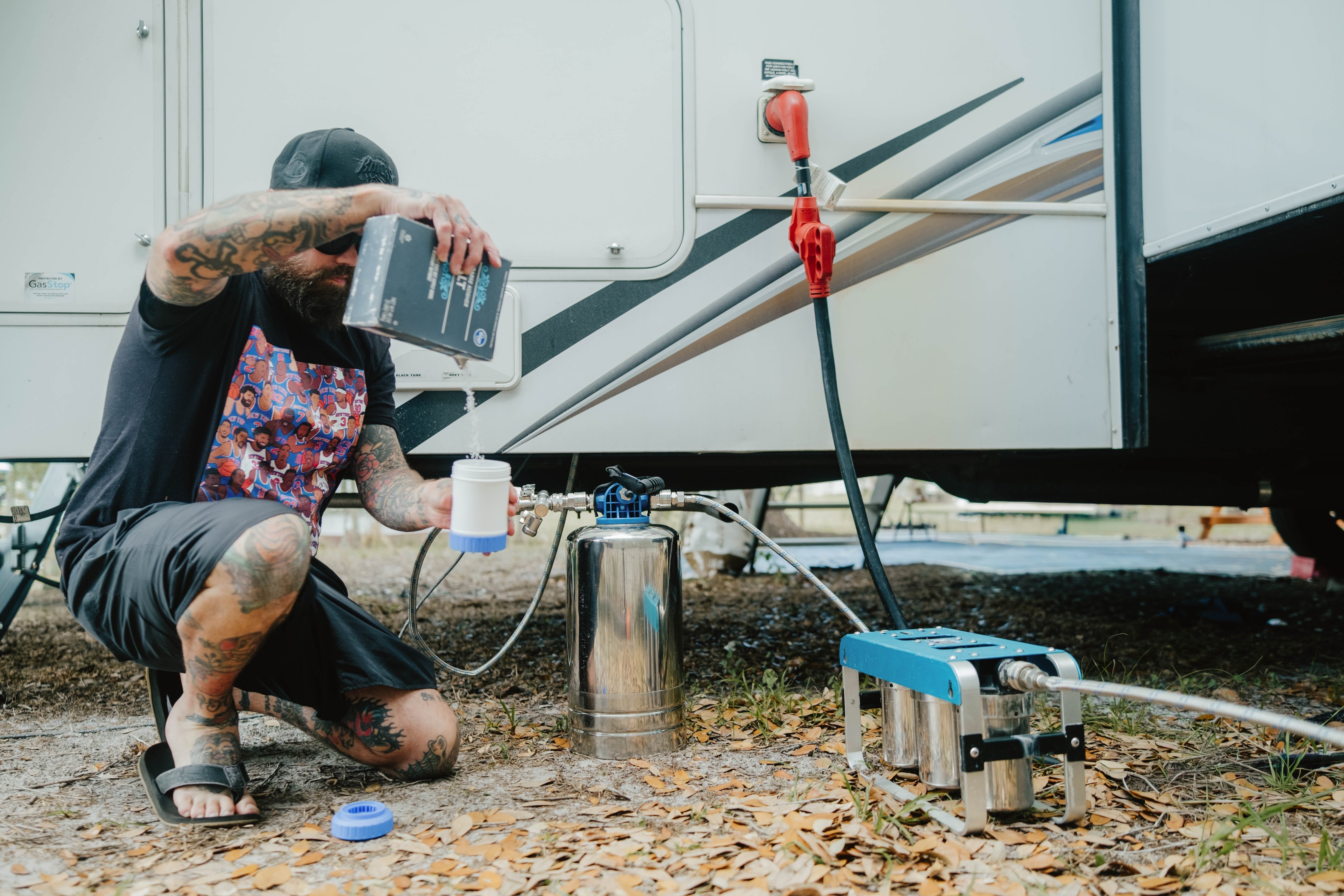
You pull into a new campground, hook up, and the water looks exactly the same as it did at your last stop. Clear, cold, running fine. But "looks fine" is often deceptive. Every region you roll through draws from a different source, and one of the biggest differences you can't see is hardness. It's not dangerous, it's not dramatic, but it adds up fast on your rig, your appliances, and even your shower.
What Hard Water Actually Is
Hard water just means water carrying a higher amount of dissolved calcium and magnesium. Rain and groundwater pick these minerals up naturally as they move through soil, limestone, and rock on the way to a well or reservoir. The U.S. Geological Survey classifies water hardness on a simple scale, typically measured in grains per gallon (gpg) or milligrams per liter (mg/L):
- Soft: under 3.5 gpg (under about 60 mg/L)
- Moderately hard: 3.5 to 7 gpg (about 60 to 120 mg/L)
- Hard: 7 to 10.5 gpg (about 120 to 180 mg/L)
- Very hard: over 10.5 gpg (over about 180 mg/L)
By that measure, a large margin of homes in the U.S. sit somewhere on the hard side of that scale. It's not evenly spread, either. The hardest water in the country tends to show up in Texas, New Mexico, Kansas, Arizona, Utah, Colorado, Nevada, and Wyoming, which happens to overlap with a lot of favorite RV routes.

(Source: https://www.usgs.gov/media/images/map-water-hardness-united-states)
How to Tell If You've Got It
Hard water announces itself in small, annoying ways before it shows up in a repair bill. Soap that won't lather the way it should. A filmy residue on dishes and shower doors. Spots on your rig's windows after a wash. Skin that feels tight or dry after a shower, hair that feels a little duller than usual. None of that is your imagination. Calcium and magnesium react with soap to form a residue commonly known as soap scum, so you end up using more soap and detergent to get the same result.
What It Does Over Time
The bigger issue is what hardness does inside your plumbing, especially once water gets heated. As hard water warms up, dissolved minerals come out of solution and form scale, a hard, chalky buildup on the inside of pipes, faucets, and water heater elements. Over time that buildup narrows pipe diameter, reduces water pressure, and makes your water heater work harder to do the same job. That's not a scare tactic, it's basic physics that the USGS and plenty of plumbers will back up. In a house, that shows up slowly over years. In an RV, with its smaller lines, smaller water heater, and tighter fittings, it shows up faster.
Worth noting: hardness itself isn't something the EPA regulates as a contaminant. It falls under a broader, non-enforceable guideline for total dissolved solids, which means nobody's required to soften your water for you before it reaches your hose. Whatever's in the source is what shows up at your spigot.

What It's Actually Costing You
Scale buildup isn't just cosmetic. Every appliance that touches hot water, your water heater, faucets, shower valves, washing machine, works a little harder once mineral deposits start narrowing a line or coating a heating element. That means more energy to heat the same amount of water, fixtures and valves wearing out and getting replaced sooner than they should, and more soap, shampoo, and dish detergent to get the same result described above. It will show up as a water heater that runs a little longer than it used to, or a faucet that needs replacing a few years early.
That's the practical case for softening: it's less about one big failure and more about a dozen small ones that quietly cost money and hassle over the life of your rig.
How a Water Softener Actually Works
A portable water softener uses a process called ion exchange. As campground or well water passes through the softener, the resin inside captures hardness-causing minerals such as calcium and magnesium and exchanges them for sodium ions. The result is softer water entering your RV, helping reduce the mineral buildup and scale that hard water can leave behind on fixtures, plumbing, appliances, and other surfaces.
Unlike a traditional whole-home softener with a large brine tank and an automatic regeneration cycle, a portable RV water softener is designed to be compact, easy to connect, and manually regenerated when needed. Once the resin has treated enough hard water, it needs to be recharged with ordinary table salt. The salt replenishes the resin so it can continue exchanging sodium for hardness minerals.
How often you'll need to regenerate depends largely on the hardness of the water you're using and how much water has passed through the softener. That makes portable softeners especially convenient for RV travel, where water conditions can change from one campground to the next. When it's time to regenerate, you add the appropriate amount of table salt, flush the softener according to its regeneration procedure, and it's ready to get back to work. There's no permanent installation or bulky brine tank required, making it a practical solution for softer water wherever your travels take you.
Why This Matters More on the Road
A house sits on one water source. An RV doesn't. You might hook up to a soft municipal supply in one state and a stubbornly hard well or reservoir supply a few hundred miles later, sometimes within the same week. That inconsistency is exactly why full-timers and frequent travelers tend to feel hard water's effects faster than homeowners do. Your RV's water heater is smaller and works harder per gallon. Your lines and fittings are tighter. Scale that would take a decade to matter in a house can start affecting flow and shower pressure in a rig much sooner. And on the comfort side, if you've ever noticed your skin or hair feeling different a few states into a trip, hardness is very likely why.

Where a Softener Fits Into Your Setup
If you're dealing with recurring hard water on the road, a compact, RV-sized softener is the most direct fix, and it doesn't need to be complicated. Blu Technology's Water Softener with SMART CAP is a 10,000-grain stainless system built for exactly this: it regenerates with standard table salt without disconnecting a single hose. If you're already running a different softener and just want to lose the maintenance hassle, the SMART CAP Universal Kit retrofits most tank-style resin softeners with the same no-disconnect regeneration.
Either way, the water at your next hookup is out of your control. What you do with it once it reaches your rig isn't.
Share:
One Dial, No Mess: A Guide to the SMART CAP and SMART CAP Universal Kit
August Featured Video: Golden Life Travelers Take On Hard Water